orthax






orthax is a library for working with orthogonal polynomials in JAX.
It provides a drop-in replacement for numpy.polynomial that works with jit,
grad, vmap and runs on CPU, GPU and TPU, and goes further with a general
framework built on three term recurrence relations that handles any family of
orthogonal polynomials, including ones you define yourself from an arbitrary weight
function.
Highlights
Familiar API:
orthax.chebyshev,orthax.legendre,orthax.hermite,orthax.hermite_e,orthax.laguerreandorthax.polynomialmirror theirnumpy.polynomialcounterparts function for function.Fully JAX native: written in pure
jax.numpy, so functions compose withjit,gradandvmapover coefficients or evaluation points.Twelve classical families built in: Legendre, shifted Legendre, Chebyshev of all four kinds, Gegenbauer, Jacobi, Laguerre, generalized Laguerre and both Hermite conventions, each in standard, monic or orthonormal scaling.
Bring your own weight:
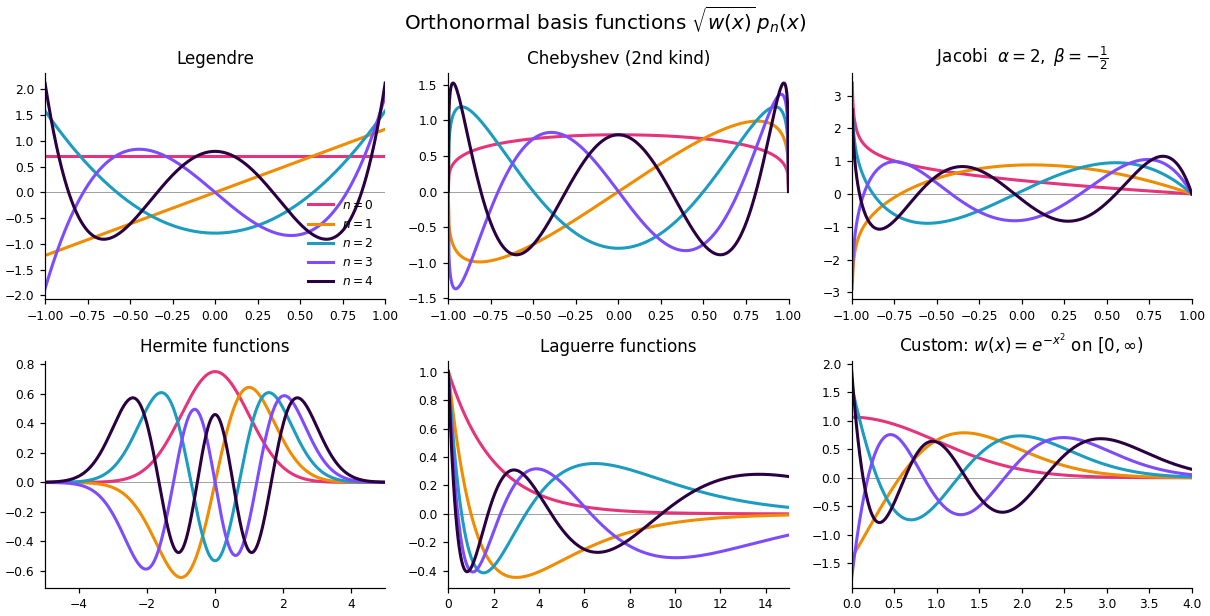
generate_recurrencecomputes the recurrence relation for polynomials orthogonal with respect to any weight on any (possibly infinite) interval, with error control.The full toolkit for every family: arithmetic, evaluation in 1D/2D/3D, differentiation and integration, least squares fitting, roots, Vandermonde and companion matrices, conversion to and from power series, and Gauss, Gauss-Radau and Gauss-Lobatto quadrature.
📖 Documentation: orthax.readthedocs.io
Quick start
A drop-in for numpy.polynomial
import jax
import jax.numpy as jnp
from orthax import chebyshev as C

x = jnp.linspace(-1, 1, 200)
y = jnp.exp(x) * jnp.sin(5 * x)

c = C.chebfit(x, y, deg=20)       # least squares fit
dc = C.chebder(c)                 # derivative of the series
ic = C.chebint(c, lbnd=-1)        # antiderivative of the series
r = C.chebroots(c[:8])            # roots of a truncated series
…that also works with JAX transformations
# gradient of a loss with respect to the series coefficients
loss = lambda c: jnp.sum((C.chebval(x, c) - y) ** 2)
g = jax.jit(jax.grad(loss))(c)

# evaluate a whole batch of series at once
batch = jnp.ones((32, 10))
vals = jax.vmap(C.chebval, in_axes=(None, 0))(x, batch)  # shape (32, 200)
Any classical family
The functions in the base orthax namespace take a recurrence relation describing
the polynomial family, so families without a dedicated numpy module get the same
toolkit.
import orthax

rec = orthax.recurrence.Jacobi(alpha=0.5, beta=-0.5)

c = jnp.array([0, 1.2, 0, 2])        # 1.2 P_1(x) + 2 P_3(x)
f = orthax.orthval(x, c, rec)        # evaluate
df = orthax.orthder(c, rec)          # differentiate
c2 = orthax.orthmul(c, c, rec)       # multiply two series

# Gauss-Jacobi quadrature: nodes and weights for the integral of f(x) w(x)
xq, wq = orthax.orthgauss(16, rec)
integral = jnp.sum(wq * jnp.cos(xq))
Custom weight functions
Generate polynomials orthogonal with respect to any weight. For example, the “half-range Hermite” or Maxwell polynomials, orthogonal on [0, ∞) with weight exp(-x²):
rec = orthax.recurrence.generate_recurrence(
    lambda x: jnp.exp(-x**2), domain=(0, jnp.inf), n=20
)

# 20 point Gauss quadrature for the integral of f(x) exp(-x^2) over [0, inf)
xq, wq = orthax.orthgauss(20, rec)
jnp.sum(wq * jnp.cos(xq))  # 0.6901942..., matches scipy.integrate.quad

# and everything else works as before
c = orthax.orthfit(xq, jnp.sqrt(xq), deg=10, rec=rec)
Supported families
Family |
Recurrence relation |
|
|---|---|---|
Power series |
|
|
Legendre |
|
|
Chebyshev |
|
|
Gegenbauer / Jacobi |
|
|
Laguerre |
|
|
Hermite |
|
|
Anything else |
|
Differences from numpy.polynomial
JAX requires array shapes to be known at compile time, so trailing zeros are not
automatically trimmed from series as they are in numpy. Use orthtrim (or the
module specific *trim functions) outside of jitted code if this becomes a concern.
For full details see the documentation.
Installation
orthax is installable with pip:
pip install orthax
generate_recurrence additionally uses quadax
for adaptive quadrature:
pip install quadax
Citing
If you use orthax in your research, please cite it using the information on
Zenodo or in CITATION.cff.